
It’s a truth universally acknowledged that an educator, at some point in their career, will be called out by their students.
For Concetta Lewis, that moment came while she was teaching middle school students with emotional impairments in Southfield, Michigan. Every morning, she and her students worked through a social and emotional learning program, talking about things like impulse control, how to manage their emotions, and empathy.
One day, as Concetta was getting on a student about something, he looked at her and said, “Ms. Lewis, you’re not showing me any empathy right now.”
Instead of being frustrated that he’d called her out, Concetta rejoiced.
“It was perfect,” said Concetta, “because it meant the program was working!”
Moments like this have motivated Concetta throughout her career. Academic progress, she believes, will come. But reaching the whole child is “where we make true progress.”
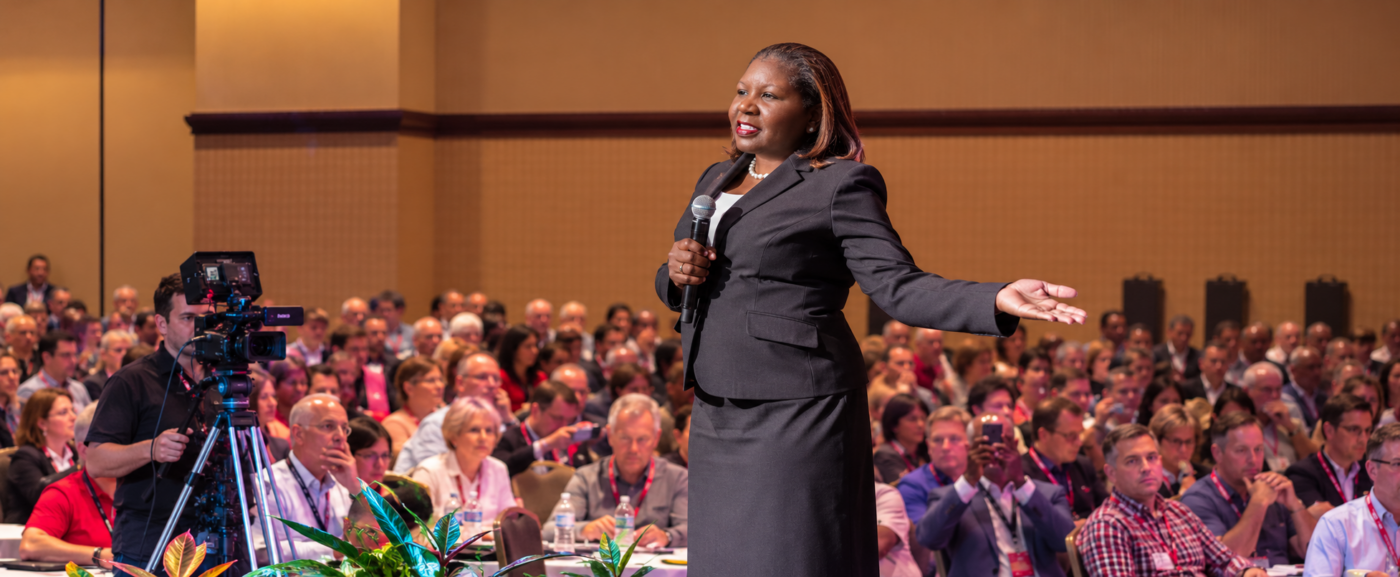
Today, Concetta is the Assistant Superintendent for the Office of Special Education at Ann Arbor Public Schools, where she oversees services for students ages 3 through 26, supports school teams and building leaders, and meets monthly with the district’s parent group. She was also elected the 2027 president of the Council for Exceptional Children (CEC). Across every role, one conviction guides her: every student deserves to learn and belong alongside their peers.
The student in Southfield was exactly the kind of learner Concetta set out to serve from the very beginning, though she almost didn’t choose special education at all.
Choosing Special Education
All her life, Concetta has enjoyed working with children and young people. As a high school junior, she returned to her elementary school to teach business basics to 5th and 6th graders through Junior Achievement, a nonprofit that brings financial literacy and career readiness lessons into classrooms. She also volunteered for the Special Olympics when she was in high school.
When she started at Michigan State University, she planned to become an attorney. She imagined practicing law during the day and volunteering in after-school programs in the evening.
“Then the light bulb came on,” she said. “What you need to be is an educator.”
Once she made the decision to be a teacher, everyone kept telling her that she should go into special education. But she wasn’t so sure. “It takes a really special person to work with children who have special needs,” she remembered thinking. “I don’t know if this is for me.”
So she read through the description of every disability category for students with IEPs. One jumped out at her: emotional impairment. To Concetta, those were the students who “maybe had family circumstances or something happened in their life” that kept them from doing their best in school.
She thought about the painful events her own family went through while she was in high school.
“I said, those are the kids I want to help,” she said, “because I want them to know that no matter what you’re going through, no matter your family circumstances, you don’t have to live in this for the rest of your life.”
Concetta changed her major to special education with a focus on emotional impairments.
Then, in a twist, she graduated and decided to teach general education instead. She believed her students were capable of succeeding in general education classrooms, and that as a strong general education teacher, she could help students avoid needing an IEP at all.
Districts had other plans. “When you’re out here with a special education degree, and people are hiring,” she laughed, “they’re like, no, we’re gonna put you in the special ed class.”
A Career of Saying Yes
Concetta’s first year of teaching was in Lansing, where she taught in a middle school resource program. After that year, she wondered whether she should move back to Detroit, where her family still lived. She told herself she needed a sign.
One summer morning, before she’d even gotten up for the day, her phone rang. “This was before the days of caller ID,” she laughed. On the other end was Dr. Emily Barum from Detroit Public Schools, calling about a job.
“That was my sign from God,” Concetta said.
Only later did she learn that Dr. Barum had met her mother, who had happily passed along her daughter’s phone number. “You know how parents are,” Concetta said.
Concetta taught in Detroit Public Schools before transferring to Southfield Public Schools. “I really thought I was retiring from Southfield Public Schools,” she shared.
Then her pastor founded a charter school and asked her to build its special education department. She hesitated. He asked again: “Please come and help us.”
So she said yes. She started in a dual teaching and administrative role. When she arrived, the school served roughly 15 to 20 students with IEPs. By the time she left as Director of Special Education, it served about 100.
Next, Concetta became Director of Special Education for the Education Achievement Authority, a reform district created for 15 schools in Detroit. She helped build the new district from the ground up, and “we saw some great progress with students in that space,” she said.
She then moved to Washtenaw County, eventually serving as Assistant Director of Special Education for Ann Arbor Public Schools. When her director retired, Concetta took a director position at Rochester Community Schools.
“Every time I go somewhere, I think I’m retiring from that place, but it does not work,” she said. “I was like, yes, this is it, I’m retiring right here in Rochester.”
Then the phone rang again. This time it was Jazz Parks, the new Superintendent of Ann Arbor Public Schools.
“We really need some support with rebuilding our team here in the Office of Special Education,” Parks told her. “Will you please come back to Ann Arbor and help us?”
Concetta’s reply: “Of course I’m gonna come back and help you.”
And with one more yes, she came full circle back to Ann Arbor Public Schools.
The Parallel Leadership Journey
While she was at the charter school, Concetta joined professional organizations like CEC and the Council of Administrators of Special Education (CASE). “I just wanted to make sure I had all the information that I need to be the best special ed administrator possible,” she said. But she wasn’t an active member, at least not yet.
That changed in 2012, when she was selected for the America Achieves Fellowship for Teachers and Principals. Fellows gathered for convenings a few times a year, and each had to complete an impact project. Her project was to become more involved with Michigan CEC. Before the organization’s annual conference, she reached out to ask how she could help. Come to the meeting, they told her.
Her active involvement turned into her running for and serving on the board. The board turned into an invitation to run for president of Michigan CEC.
After her term as Michigan CEC president, she served as president of the Michigan Association of Administrators of Special Education (MAASE). Along the way, she joined the board of directors for National CEC, and she was elected its 2027 president.
“I’m always looking at how I can grow, and how I can continue to have an impact on the field,” she said.
Stand Up and Advocate for What You Believe
In her younger years, Concetta’s father gave her some advice that she’s been turning over ever since: stand up for what you believe in and speak up for what you think is right. “My work … comes from the advocate that my father created in me,” she said.
For Concetta, few things are more worth standing up for than inclusive learning environments. Throughout her career, she has watched students with disabilities succeed in general education settings alongside their peers. It keeps her motivated, and it reassures her that inclusion can be done.
“If we can create spaces where all students feel like they belong and have that sense of belonging and community, that’s what I’m looking for,” she said.
That isn’t always how special education works today. In Michigan, students may not receive services at their neighborhood school. Instead, some ride a bus 30 to 45 minutes across town to get the support and services they need.
To explain why that matters, Concetta puts herself in a parent’s shoes.
“If it were my child who was playing up until the age of five outside with little Susie, and now, all of a sudden, my baby can’t go to kindergarten with little Susie,” she said. “She has to go to a school 30 minutes away, and she’s built all those relationships.”
She has seen what’s possible when students grow up together. Years ago, while she was working as a teacher consultant at a high school, a student in the hallway was having a meltdown. The student walking beside Concetta wasn’t bothered. She simply said she’d known him since kindergarten.
Concetta was struck by that student’s empathy and understanding. Instead of wondering what was wrong with him, she understood him, because they had grown up together.
“There’s just one Macy’s department store, right? There’s not a special Macy’s for people with IEPs,” Concetta said. “It’s one Macy’s.” Belonging in school, she believes, prepares students for belonging in their wider community.
Her dream is that when students show up to their neighborhood school, no matter what their needs are, the school finds a way to bring support and services to them. She’s candid that getting there will take work: more training for general education teachers, more staff spread across more schools, a greater investment in special education, and much closer collaboration between general and special education.
In Ann Arbor, that work is already underway through the district’s Building Inclusion Coach program. Coaches might be general education teachers, special education teachers, or paraeducators. In addition to their regular roles, they volunteer for additional training and serve as advocates for inclusive practices in their buildings.
When Concetta followed up with recent participants last year, general education teachers told her it was one of the best opportunities they’d had and that they now felt much better equipped to support students in inclusive settings.
That shift matters to her. Too often, general educators think special education teachers have “some magic fairy dust,” she said. Then they realize, “what we’re doing is just working with each student as an individual and supporting them with what they need.”
“When they realize there’s no magic fairy dust, we all have it within us,” she said, “that to me is what makes the difference.”
Not every building in Ann Arbor has an inclusion coach yet. Concetta’s goal is for every school to have at least one.
Leading Alongside, Not Above
Concetta can name the defining moment of her career. In 2012, she spent a week in Washington, D.C., as a Civil War Washington Teacher Fellow with Ford’s Theatre, studying Frederick Douglass and his relationship with Abraham Lincoln, with time at Ford’s Theatre, the Frederick Douglass National Historic Site, and President Lincoln’s Cottage.
One idea from that week stayed with her: Lincoln’s “team of rivals.”
“Even though everybody had competing demands and was looking at things from different perspectives, he was able to bring us together to save our country,” she said.
It shaped how she approaches “people who might think differently from me,” she said, and how to “move past some other things for the sake of what’s truly important.” For Concetta, inclusion isn’t only something she asks of teachers. It’s how she leads.
She’s with the team, and they know it. Concetta blocks every Wednesday to visit schools. Last year, when a new student who had never attended school joined a middle school autism program, she served as the student’s paraeducator on the first day. It helped the team see things differently and realize they could manage the situation.
She’s not in this alone, and she knows it. “I have to rely on the folks that are on my team and the expertise that each of those individuals brings to the table, because they each bring a different perspective,” Concetta said. She welcomes questions and pushback, so the team considers everything it should before making a decision.
She makes decisions as if the student were her own child. Concetta starts with the data and evidence. But at the center of every decision is one question: Is this for the benefit of the students, or for the adults? “We are making decisions based on students,” she said.
Looking to the Future with CEC
Every CEC president chooses a theme. Concetta asked herself what her building teams kept struggling with. The answer became clear: student mental health.
“That’s going to be my area of focus as president,” she said. Her goal is to make sure schools support students not only academically, but also in their mental health, “because that is where we’re having the biggest challenge in the school setting right now.”
In a way, the theme brings Concetta back to where she started: choosing special education to support students whose emotional struggles were getting in the way of school.
Concetta also sees a bigger role for CEC: bringing people together. Too often, she said, parents, teachers, administrators, and others are “working in isolated pockets.” Real change requires everyone at the same table.
She envisions CEC at the center of a broad coalition, alongside AASA, The School Superintendents Association; the National Education Association and other teachers’ unions; principals’ associations; and the National PTA.
“If we can bring all of those voices collectively together … to continue to ensure that services are maintained, that there’s funding for programs,” she said, “if we’re all working together, then I think we can make that happen.”
Lead with Empathy
When asked what advice she would give aspiring special education leaders, Concetta named three things: be genuine, be authentic, and be empathetic.
That means thinking about things from the perspective of:
- The general education teacher who feels overwhelmed because they have to log all the accommodations
- The teaching assistant who just got bitten, kicked, and spit on
- The special education teacher writing IEPs late at night
- The building principal who just got cussed out by a parent upset about what happened
In each of those moments, she said, the most important thing a leader can do is empathize, listen to what people are saying, and let them feel heard.
“I think maybe that’s it,” she said. “Listen.”
Her message to readers follows the same thread. Especially for those who haven’t navigated disability themselves or with a family member, she said, “you just don’t think about it in the same way.” She challenges all of us to put ourselves in the shoes of the learner and their family.
When Concetta first considered special education, she wasn’t sure she was the right person for it. “It takes a really special person,” she thought.
Decades later, from a middle school classroom in Southfield to a district office in Ann Arbor to the national stage, it turns out Concetta Lewis is that really special person.
